Post-Remediation Verification Testing (also known as PRV testing) is the process of confirming that mold remediation was performed correctly and that the property is safe to reoccupy. It typically includes air sampling, visual inspection, dryness verification, and in advanced cases, molecular testing. Read more to learn why homeowners need to be tuned in on each part of PRV testing, and why for each remediation team the PRV may be different.
PRV Testing After Mold Remediation: What It Confirms
Post-Remediation Verification testing is meant to confirm that a remediation project was completed successfully…
…but here’s the reality most homeowners never hear:
- There is no universal, standardized PRV protocol that all remediation companies must follow.
Each remediation provider determines how they verify their own work, and which third-party inspector (if any) is brought in to perform the assessment.
PRV Testing Alone does not mean “Mold Remediation was Performed Correctly”
This creates a wide spectrum range of quality and transparency across the industry.
Some companies use truly independent assessors and evidence-based methods, an approach that offers homeowners clear, trustworthy data and peace of mind.
“Others rely on internal or affiliated teams that blur the lines between who performed the work and who is verifying it. This might mean that in some cases, an inspector, testing provider, and remediation company may all be closely connected. This leads to a grievance pending situation, and leaving homeowners unsure whether the results are truly objective.” -Fictitious Remediation Investigators (Not a real organization)
Is PRV Testing Required after Mold Remediation?
No, your diligence is required.
There is no standard PRV test nor is there an organized remediation investigation governing body or enforcing agent to control the mold and water damage industry.
Because there is no governing body enforcing a unified PRV standard, homeowners must pay close attention to how a company proves their work.
The safest path is choosing a remediator who embraces transparent, science-based verification, uses independent third-party assessors, and welcomes accountability instead of avoiding it.
A reputable company will always show you the data, not just ask you to trust the process.
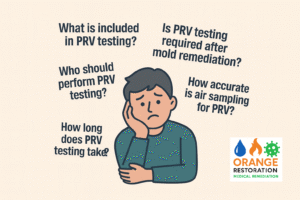
A homeowner plagued by questions: “What is included in PRV testing?” “Is PRV testing required after mold remediation?” “Who should perform PRV testing?” “How long does PRV testing take?” “How accurate is air sampling for PRV?”
Why Most Post-Remediation Verification Falls Short
Many standard “Post-Remediation Verification Testing” protocols focus on a limited set of checks that can miss critical contamination, leaving homeowners with a false sense of security.
Most “Post-Remediation Verification testing” is:
- Air sampling, which often captures visible spores but misses ultrafine particles (UFPs) that can trigger health issues in sensitive individuals.
- Visual inspection, which identifies obvious mold growth but cannot detect hidden spores, fragments, or microscopic contamination behind walls, in HVAC systems, or inside building cavities.
- Moisture readings, which confirm surfaces appear dry, yet fail to identify tiny moisture pockets or residual microbial activity that could allow mold to regrow.
Taken together, these checks may suggest the remediation is complete, while microscopic contamination and airborne particles remain, especially concerning for medically sensitive populations, including those with CIRS.
What “PRV Clearance” Specifically Means
Another term used is the PRV Clearance, which also sounds quite official, all this means is that the PRV Testing process is completed, the third party testing or whatever was used as proof of work, has deemed their work completed. This often creates a sense of safety and confidence in the work done, and for remediation teams they feel they are off the hook, their work is validated as complete.
Homeowners may assume a simple PRV clears the home, but without comprehensive testing, lingering contaminants can continue to impact health.
Pro Tip: Avoid secondary mold risks by making sure professionals are using proper drying methods and testing humidity.
This gap highlights the need for a Medically Sound PRV protocol, one that goes beyond surface-level inspections to measure ultrafine particle loads, hidden contamination, and cross-contamination risks, providing a verifiable, science-backed standard for safety.
Because standard PRV often misses these hidden threats, it’s essential to understand what a medically sound approach looks like and how it ensures a home is truly safe. Asking the remediator to explain their PRV testing process is essential. Asking the real question homeowners need to care most about: will the home be “Medically Sound” and “CIRS-safe” once the remediation work is completed?
What Medically Sound PRV Testing Should Look Like
A truly medically sound Post-Remediation Verification testing goes far beyond surface-level inspections and basic air sampling.
For homeowners concerned about hidden contaminants or have medically sensitive individuals, standard testing can miss critical risks, leaving a home unsafe despite the appearance of a “finished” remediation. They even have evidence in their favor that they completed their work, but you’re left to figure out the problem is still there, hidden deeper.
Medically Sound PRV testing elements:
- Air sampling alone is insufficient. Standard air tests often detect only a small fraction of the biotoxins and ultrafine particles (UFPs) that remain after water damage and mold contamination, sometimes less than 5%. These microscopic particles can travel through HVAC systems, settle on surfaces, and continue to impact indoor air quality long after the remediation is “complete.”
- Molecular-level testing is required. Tools like ERMI, HERTSMI, or qPCR allow experts to identify specific mold species and their byproducts. Unlike visual inspection or traditional air sampling, these tests provide reliable, science-backed data to confirm that contamination has truly been addressed.
- HVAC systems must be cleared separately. Hidden spores, dust, and mold fragments can circulate throughout a home via ductwork, spreading contamination even after walls and floors appear clean. Testing and clearing HVAC components is essential to ensure that airborne particles do not reintroduce risks.
- Particle loading is critical. PRV should measure overall particle levels, not just visible spores. By tracking ultrafine particles and microscopic fragments, remediation teams can verify that the home environment is genuinely safe for sensitive individuals.
Why a Medically Sound PRV Testing matters for Homeowners:
- Confirms that even hidden contamination was removed
- Prevents regrowth or deeper secondary mold by using proper drying methods
- Ensures HVAC isn’t spreading spores
- Helps medically sensitive individuals return safely to home
A Medically Sound Post-Remediation Verification Testing (PRV): Ensuring the Job Is Truly Done Right
Taken together, these elements define a medically sound PRV, a protocol that confirms the work is complete at both the structural and microscopic levels, providing homeowners with confidence that the remediation was effective and thorough.