…And Why San Diego’s “Perfect Weather” Makes HVAC Issues Worse.
When it finally gets cold enough in Southern California to switch on the heater, most people don’t expect the blast of stale odor that follows. But in San Diego, where the weather is mild enough that HVAC systems sit unused for months, this surprise is practically a seasonal tradition.
Pro Tip: If you haven’t thought about preparing for the winter months or rainy season, you may want to do these few things to prepare for the colder months as soon as possible.
Some San Diego homeowners forget about our HVAC systems because we barely need to use them. Some cooler summer years, you might skip AC altogether. Other years, you might only run the heat two or three weeks in total. And that long period of inactivity is exactly why the first blast of warm air can hit you with a puff of dust; an odd “musty” odor; or worse… a familiar symptom flare if you’re CIRS-sensitive.
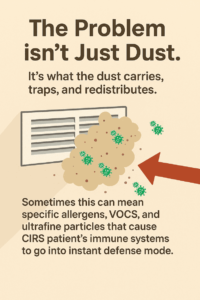
The Problem isn’t Just Dust.
It’s what the dust carries, traps, and redistributes.
Sometimes this can mean specific allergens, VOCS, and ultrafine particles that cause CIRS patient’s immune systems to go into instant defense mode.
This pattern is consistent with what Indoor Environmental Professionals (IEPs) and CIRS-literate clinicians observe in homes where the HVAC system was never included in the original remediation plan.
Likewise, for many of our San Diego based CIRS-sensitive clients, sometimes this is the missing link.
This means, in some cases, they’ve remediated the home, cleaned every room, and still feel unwell until the HVAC is properly addressed.
Pro Tip: Understanding how ultrafine particles behave may help you with understanding maintenance issues, avoid costly damages, and keep your home safe from contamination. Learn about Aerosol Science, and how air in a home moves, especially during the holiday season.
The Hard Truth: HVAC Is the Most Efficient Contamination Distributor Ever Invented
Sure, we all love the warmth an HVAC system can bring to the home, but have you ever thought of doing the work to clean the airways after the season’s use? This is a real project, and oftentimes, homeowners don’t know where to start, so they don’t even do it. They let it sit.
From a building-science perspective, HVAC systems are designed to move particles. That’s the job of the HVAC system. However, when the system has not been going, it has likely been accumulating dust and UFP debris that move through the system even without our knowing.
But an HVAC system in a water-damaged or mold-affected home?
This design becomes a liability for CIRS patients who often fear HVAC systems. Like a UFP loaded cannon, the HVAC blasts these resting ultrafine particles into the air.
Here’s why HVAC is the #1 cross-contamination vector in CIRS environments:
1. The HVAC Pulls Contaminants Into the System
Dust, mold fragments, actinomycetes, endotoxins, VOCs, and ultrafine particles get drawn straight into returns, especially:
- ceiling returns
- leaky ductwork
- dusty closets
- old filter housings
Pro Tip: Learn about negative and positive air pressure, and how particles behave in your home beyond the HVAC system.
2. It Traps Contaminants in the Worst Possible Places
Even a CIRS-sensitive home often sees buildup in:
- coils
- blower wheels
- duct interiors
- insulation lining
- filter racks
- condensate pans
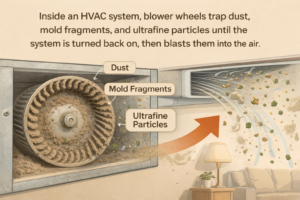
And since the system stays idle for months, these particles settle, bind, accumulate, and decompose, creating that “first heat of the season” smell.
3. Then It Blasts Those Contaminants Into Every Room
When the heat finally kicks on, the HVAC becomes a contaminant amplifier, spreading ultrafine particles and microbial fragments evenly through the home in seconds.
For someone with CIRS or mold sensitivity, this isn’t just uncomfortable, it’s a health trigger.
Why HVAC Systems Aren’t Better at Filtering
Simple Explanation: Because they were never designed to clean air, only to move air.
Most home HVAC systems prioritize Airflow, comfort and energy efficiency
- Not air purification.
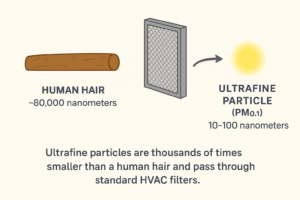
To move enough air through the system, they require low-resistance filters, which means the filters must be thin and porous, catching only the large particles (lint, hair, debris). Not the particles that matter most for health.
Why This Matters Specifically for CIRS Patients
Particles that a healthy person barely notices are enough to trigger:
- Headaches
- Fatigue
- Skin flushing
- Cognitive fog
- Sinus inflammation
- Dyspnea or chest tightness
The HVAC system becomes the delivery mechanism for the very particles that CIRS patients are supposed to avoid.
Even if the source was fixed…
Even if the remediation was done well…
Even if surfaces were cleaned…
If the HVAC was not addressed, a CIRS patient often doesn’t improve.
This is why so many CIRS healing journeys stall for “unknown reasons” and the HVAC ends up being the missing piece.
What to do if You Have Mold in Your HVAC System?
“In cases where you suspect mold in your HVAC, we recommend getting an Indoor Environmental Professional (IEP) involved. An IEP is a hygienist whose job is to help you pinpoint the mold problem with professional testing but also a scope of work to properly remove the mold contamination. If not done properly, HVAC systems can quickly cause a much greater home-wide mold problem.” – “Why Does my HVAC Smell So Musty?”
Pro Tip: Read the “Steps for Handling Mold in HVAC System” section of our blog “Why Does my HVAC Smell So Musty?”
Why HVAC Filtering Fails CIRS Patients
Even a “good” HVAC filter fails to capture:
- Ultrafine particles
- Microbial fragments
- Mycotoxins
- VOCs
- Actinomycetes
- Fragments <0.3 microns
CIRS patients react not to big particles, but to the smallest, electrically active, chemically reactive particles, the exact ones HVAC filters were never built to stop.
“It is common to have a goo or slime that builds up in a drain pan, this often will clog it. This is called biofilm, a bacterial growth mostly made up of Zooglia bacteria. Dehumidifiers also have this problem, and for CIRS patients or mold sensitive, you need to clean these areas often.” –“Why Does my HVAC Smell So Musty?”
The HVAC system becomes the cross-contamination superhighway:
- pulling particles from wall cavities, attics, crawlspaces
- loading them into the air handler
- redistributing them into every room
Put simply:
The HVAC was built for comfort, not medically sound air quality.
A Final Word: Winter Is Hard Enough
For many people living with CIRS or complex chronic illnesses, the colder months bring a different kind of anxiety. This is the season when we rely on heat, yet heating often becomes the very thing that provokes symptoms. That’s not just inconvenient, it’s deeply discouraging, especially when you’ve already invested so much effort into getting your home back to baseline.
This is where empathy matters.
If you’re feeling defeated, overwhelmed, or confused about why turning on the heat seems to set you back, you’re not imagining it, and you’re not alone. HVAC systems in mild-weather regions like San Diego behave differently because they sit dormant for long stretches. When they fire back up, the entire system wakes up with them, releasing months of accumulated ultrafine particles, microbial fragments, and VOCs in seconds.
…Your Air System Shouldn’t Make It Harder
But the good news is:
You have options, and not all of them involve relying on your HVAC.
CIRS-friendly supplemental heating, medically sound air-cleaning strategies, and proper HVAC remediation can make a dramatic difference.
Many clients find relief with:
- Radiant or infrared heaters (no ducts, no blowers)
- Portable medical-grade air purifiers (down to ultrafine particle capture)
- Small Particle Cleaning to reset the indoor environment
- Upgrading filtration and sealing return leaks as part of a remediation plan
- Bringing an IEP in early to help guide decisions with real data
Most importantly: you deserve a home that feels safe, not one that ambushes you every winter.
If this season is tough for you, please know that it’s a valid body response.
CIRS Patients are Not Fragile, they are Warriors! #CIRSWarriors
Listen to your body, slow down, and don’t let anyone dismiss your reactions as “just being sensitive.” CIRS patients aren’t fragile, we have seen many strong battles from CIRS warriors, we are here to say, the environments are weaker.
Your sensitivity is not necessarily a weakness, it could be seen as a super power, your body demands a clean environment, and you can detect if it is not clean, even down to hidden ultrafine particles.
While others settle in and make their immune systems work to clear the toxins, your body says “No more! Get me out of this toxic soup!” this is not an easy message to listen to, but it is clear.
Your body may be responding to hidden contamination no one should be exposed to at all.
And if you need support identifying a hidden HVAC contamination source, creating a medically sound remediation plan, or figuring out the source of mold odors, our team is always here to help San Diegans find real, science-backed relief.