In 20 years as remediators, we have taken on many water damage or mold projects that other remediators didn’t properly complete, jobs that had cross contamination issues, or concerns of the homeowner not being met. Negative pressure and contamination have been a major concern for our team to master.
While we have had many secondary mold projects, DIY Mold repairs gone sideways, and of course attentive homeowners with critical health concerns.
Throughout our professional trades work, we have experienced it all regarding this topic of containment, cross-contamination, aerosol science, and air quality sciences.
Aerosol science has changed, we have had evolutions in the science in real time, and our team has adjusted and educated our clients on the cutting edge knowledge on the topic.
“Understanding the significance of the complex flow and pressure distribution problems created by the interaction of the building envelope with the mechanical system and climate can lead to changes in building design, commissioning, operations, maintenance, diagnostics and rehabilitation.” – Air Pressure and Building Envelopes, Building Sciences
Our team has always worked to be on the edge of the aerosol sciences to better understand containment and behavior of ultrafine particles.
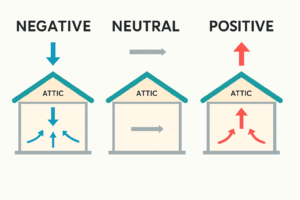
Air always moves from high pressure towards → low pressure, which means any contaminants in those areas will be sucked into living spaces floating freely in the air.
What Negative Pressure Really Means in a Home Environment
Negative pressure simply means the air inside a space is at a lower pressure than the surrounding areas.
When that happens, the space begins pulling air from anywhere it can, such as attics, crawlspaces, wall cavities, under doors, HVAC closets, and even outdoors.
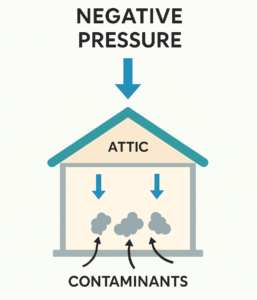
See in the image how the low pressure in the living space causes contaminates in the attic, walls, and crawlspace to be pulled into the living space? This is an example of a Negative Air Pressure Event, where a single force pulls air from all the spaces you do not want air to come from.
The Real Problem: Ultrafine Particle Behavior
Ultrafine particles (UFPs) behave differently from traditional mold spores or dust.
“Suspended particle sizes may range from a few nanometers (nm) to hundreds of micrometers (µm) in diameter. For comparison a human hair may be between 20 to 180 µm in diameter. Particles can be manufactured or naturally occurring.” –CDC regarding NIOSH studies on how to protect workers from harmful effects of aerosols.
Because they are <0.1 microns, they:
- Stay suspended for hours to days
- Move with the slightest air current
- Bypass filters not rated for ultrafine capture
- Pass through wall cavities, recessed lights, gaps, and outlets
- Accumulate inside HVAC systems
- Track into bedrooms and clothing storage areas
Negative pressure accelerates this spread, turning a single contaminated area into a whole-home exposure. This is another reason why so many CIRS patient homes experience “secondary mold” after poorly controlled mitigation.
Many water mitigation companies create negative pressure without understanding:
- How pressure differentials drive contaminant migration
- Why CIRS homes require positive pressure control during containment
- How attic/crawlspace particulates enter living spaces during a demolition
The science behind particle movement is worth understanding, especially if you want to avoid disturbing ultrafine particles or VOCs.
Ultrafine Particles Don’t Just “Move”: Pressure Events Turn UFP Into an Aerosol Cloud
Most homeowners imagine particulates as dust that sits until something disturbs it.
But ultrafine particles (UFPs) don’t behave like dust at all, and their “stickiness” depends on humidity, surface chemistry, and electrostatics.
For a rare example, we look at a case study by NOISH scientific drug lab, this lab contains many illegal drugs and some of them being volatile compounds, but all having nano-particles that can move just because of air pressure changes.
“The two labs were separated by a shared hallway and had common restrooms and a break room. Detectable levels of (various illegal drugs) were found on several surfaces … in the toxicology lab and hood sashes, keyboards, and door handles in the crime lab. But none of the surface samples NIOSH collected exceeded the state remediation level for methamphetamine contamination of 1.5 mg/cm2, and tests of employees’ hands did not identify drug contamination. According to the NIOSH report, drug (particles) may have moved between labs because of incorrect pressurization within the facility that allowed air to flow from both labs into the hallway. Air is supposed to flow from low-hazard areas to high-hazard areas, according to laboratory ventilation guidelines. NIOSH recommended that the facility modify the ventilation system to maintain differential pressures.” –American Industrial Hygiene Association, article regarding the NOISH Drug lab case study.
Here’s the science simplified:
1. Many contaminants start out sticky or settled
Examples:
- Mold fragments stuck to insulation
- Mycotoxin residues adhered to sheathing
- Soot and wildfire particulates clinging to framing
- Dust bound by humidity to surfaces
- Fine debris sitting inert in wall cavities
If these UFP are left undisturbed, these particles aren’t airborne.
2. Negative pressure creates shear forces that lift particles into the air
When the air is pulled aggressively from one zone to another, those forces:
- Break surface adhesion
- Dislodge particles from insulation
- Lift fragments and dust from cavities
- Pull aerosols off HVAC components
- Disturb settled particulates in attics and crawlspaces
3. Once airborne, UFPs behave like smoke
Remember this important detail, because UFPs are less than 0.1 microns in size, they:
- Remain suspended for hours to days
- Bypass most filters
- Diffuse into bedrooms and closets
- Enter the HVAC return and spread evenly throughout a home
This is why a single negative pressure event during demolition can contaminate the entire house. It is not just that the particles move, the negative pressure converts settled particulates into an aerosol cloud.
For example, this is how entire houses become contaminated during a simple bathroom demo:
- Negative pressure is set up.
- The containment is not airtight.
- Air rushes from attic/crawlspace/walls into the living area.
- Ultrafine particulate becomes airborne.
- Contamination spreads beyond the work zone.
This chain reaction is predictable, and entirely preventable.
But only if pressure is monitored, controlled, and verified in real time.
Many mold fragments, insulation fibers, and mycotoxin residues start out sticky or inert, but when a contractor pulls aggressive negative pressure through a work zone, the shear forces lift them off surfaces and into the air.
Once airborne, these ultrafine particles behave like smoke and spread through the home.
How Pressure Imbalances Can Contaminate Your Entire Home
Most remediators who have failed containment, reported that they had accidentally created “uncontrolled negative pressure,” which pulls contaminants into the home instead of containing them.
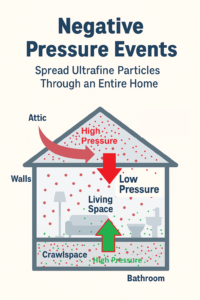
This image demonstrates how a negative air event pulls air from both the attic, crawlspace, and walls. There are green and red dots representing particles and arrows showing the air flow into the living spaces throughout your home.
Like the image above illustrates, pressure differentials don’t just redirect air, they pull contaminants out of hidden spaces and disperse them into living areas.
When the pressure inside a room drops even a few Pascals below adjacent zones, the makeup air comes from:
- The attic
- The crawlspace
- Wall cavities
- Behind tubs and showers
- Electrical penetrations
- HVAC chases
- Recessed light gaps
Why Most Containment Failures Start With Uncontrolled Negative Pressure
Most mitigation failures have nothing to do with mold growth, they’re caused by pressure mistakes.
Contractors often assume “negative air = safe containment,” but without precise control, it does the opposite. As this air rushes into the low-pressure space, it pulls particulates with it, mold fragments, insulation fibers, rodent debris, wildfire smoke residue, and ultrafine particles that normally remain stuck to surfaces. These contaminants become airborne, move with the airflow, and settle in the very areas you are trying to protect.
This is why “uncontrolled negative pressure” can cause whole-home cross contamination in a matter of minutes. Like a vacuum burst almost, once an event happens, the contamination has already been done as particles are already aerosolized and will be in the air for possibly hours or days, spreading like a cloud.
CIRS homes require a very different pressure strategy than standard water-damage work.
Why Standard Mitigation Accidentally Pulls Contaminants Into the Home
Common failures:
- Cuts made without shutting off HVAC
- Open top plates pulling air from the attic
- Bath fans running during demo
- Air movers operating in the same space
- Air scrubbers exhaust improperly ducted
- No differential pressure monitor
- No smoke testing to confirm integrity
Even a 2–3 Pascal difference can be enough to draw contaminants from dirty zones directly into clean living areas.
How Homeowners Can Tell If Their Home Was Contaminated During Remediation
Many call us with the same questions about remediators who have left behind a mess, often the mess is not even visible. We are talking of course about ultrafine particles being left behind, but also cross contaminations of dust, odor, VOCs, and mold spores. This can be quite a difficult journey to navigate.
- Dust suddenly appears after demo
- New odors from attic/crawlspace
- HVAC spreading fine gray dust
- Symptoms worsening after containment
- Black dust on horizontal surfaces
- Fine particles settling in bedrooms
Why CIRS Homes Require Positive Pressure, Not Negative Pressure
Homes with CIRS occupants cannot tolerate uncontrolled particulate migration.
For these clients, the goal is to push air outward, not pull air inward as this leads to contamination.
Positive pressure:
- Keeps contaminants inside the work zone
- Prevents ultrafine particles from entering bedrooms
- Protects HVAC pathways
- Preserves the client’s breathing zones
- Reduces recontamination of cleaned areas
This is the opposite of what most mitigation companies do, which is why so many CIRS patients get worse during traditional remediation.
How Attic and Crawlspace Air Enters Living Areas During Demolition
When demo creates negative pressure, the makeup air enters from the least-resisted gaps:
- Unsealed can lights (common)
- Attic hatches
- Wall top plates
- Plumbing penetrations
- Electrical conduits
- Crawlspace rim joists
- Gaps behind tubs/showers
- HVAC return trunks
Attics and crawlspaces almost always contain:
- Mold spores
- Rodent feces dust
- Insulation fibers
- Wildfire particulates
- Ultrafine contaminants from outdoor pollution
All of which can be pulled directly into bedrooms and living spaces.
Your home becomes the filter, and you breathe the byproduct.
The Simple Physics of Mold Spreading
Mold does not spread because it “grows fast” or moves on its own, mold does not have legs or any means to move itself. Mold spreads because air moves the mold’s spores!
Every pressure change moves spores, fragments, and ultrafine particulates into new areas.
Three rules govern movement:
- Air flows from high → low pressure
- Air takes the path of least resistance
- Particles ride on air currents
Remember, negative pressure turns your entire home into a vacuum that sucks contaminants into clean zones.
How We Prevent Negative Pressure Contamination During Mold Remediation
At Orange Restoration, we use medically sound remediation protocols designed to protect sensitive occupants, including those with CIRS, MCAS, and other inflammatory conditions. Preventing cross-contamination is the foundation of our work.
Here is how Medically Sound Remediators ensure contaminants stay inside the work zone, contained and not free in your home:
Active Differential Pressure Monitoring: We do not guess. We monitor pressure in real time using calibrated instruments to maintain safe, controlled pressure relationships between clean and contaminated areas. This prevents sudden pressure drops that cause particulate migration.
Smoke-Stick Containment Testing: Before any demolition begins, we verify containment integrity using visual smoke tracers. Every seam, corner, ceiling edge, and doorway is tested until airflow is stable and predictable.
Positive Pressure Control for CIRS Homes: For medically complex clients, we reverse the typical setup. Instead of pulling air inward, we push clean, filtered air outward, keeping contaminants inside the work zone and protecting bedrooms and breathing zones.
Real-Time Ultrafine Particle (UFP) Monitoring: UFPs are invisible to the eye but central to medically sound remediation scope of work. We track particle counts using professional laser-based monitors so we can see contamination events before the homeowner ever could.
HVAC Isolation and Protection: The HVAC system is the #1 spreader of particles if left open. We seal returns, isolate supply lines, protect the air handler, and ensure the system cannot pull air from the work zone.
Attic and Crawlspace Sealing: We locate and seal common infiltration routes, can lights, top plates, chases, rim joists, soffits, and bath fan cavities, to prevent “hidden zones” from becoming contamination sources.
Medically Sound Remediation Protocols: Our protocols follow industry standards that go beyond conventional S520 approaches and incorporate small-particle, mycotoxin-aware methods necessary for sensitive environments.
CIRSx Training Compliance: Our medically sound remediation team is trained in CIRSx protocols, ensuring our containment, cleaning, and air-control methods meet the standards required for CIRS-affected homes.